
Miami Cost Segregation for Short-Term Rentals
Cost segregation for short-term rentals in Miami and South Florida
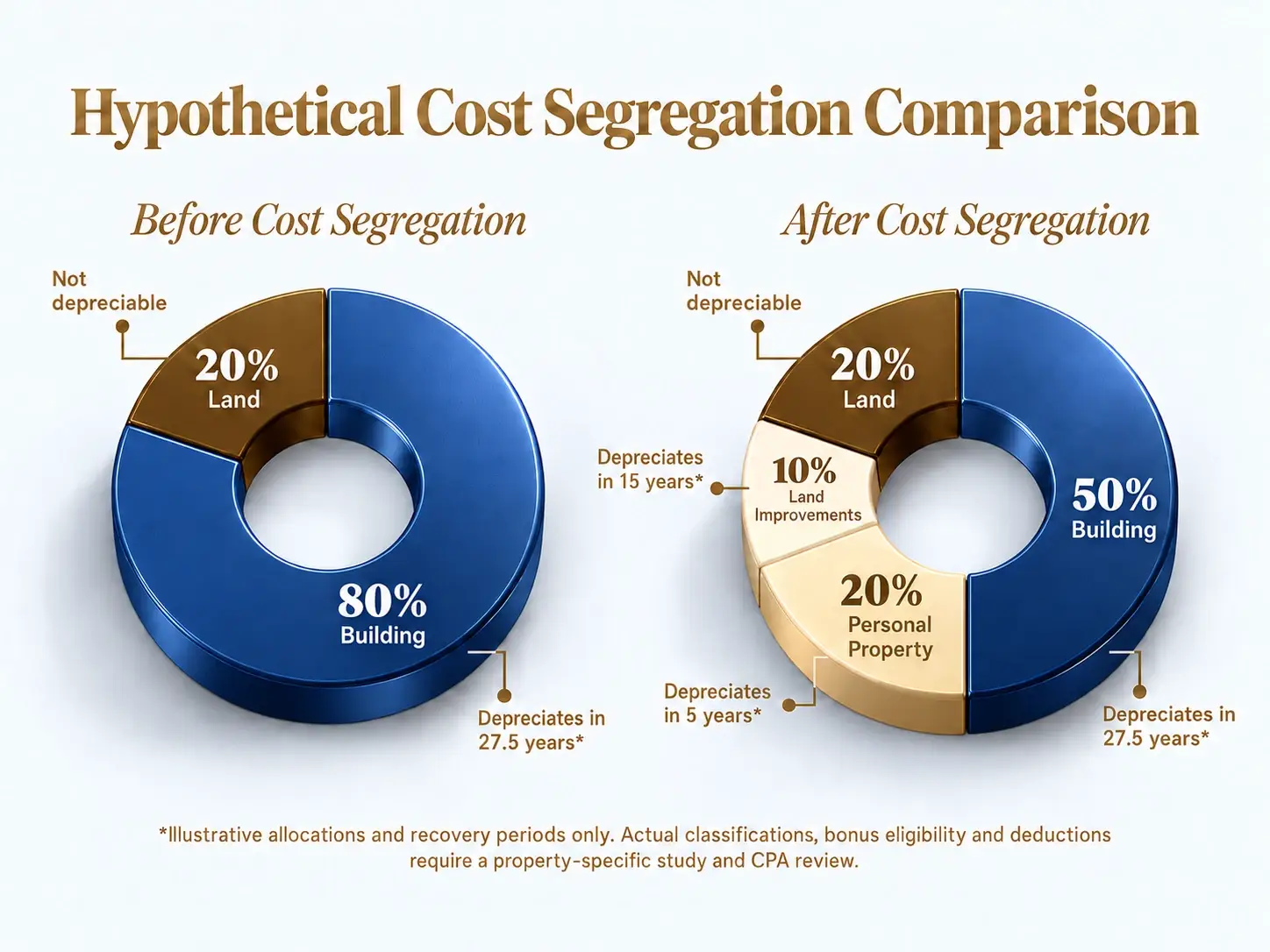
Cost segregation for short-term rentals identifies eligible property components that can be depreciated faster than the building itself. For buyers comparing Miami real estate, Miami condos, South Florida investment properties and pre construction condos, it is one part of the ownership analysis—alongside lawful rental use, operating expenses, financing and resale plans.
This guide is for investors evaluating vacation rentals, Airbnb and Vrbo properties, and rental-permitted condominiums in Miami-Dade, Broward and Palm Beach counties. Dan Maza, PA, and Miami Real Estate Trends help with property selection and project information. Your independent CPA and cost segregation specialist must determine classifications, deductions and filing requirements for your circumstances.
The essential distinction
A faster depreciation deduction is not a tax credit, guaranteed refund or increase in rental income. Whether it reduces your current tax bill depends on eligibility, participation, personal use and applicable loss limits. A property should make economic sense before any projected tax benefit.
1. What a cost segregation study does
A property purchase can include a building, land, equipment and other improvements. A cost segregation study supports how depreciable costs are assigned among the relevant asset categories. It should reconcile to actual tax basis; it does not create additional acquisition costs or make land depreciable.
| Component to evaluate | Potential treatment | Question for your adviser |
|---|---|---|
| Furniture, appliances and eligible personal property | Shorter recovery periods, often 5 or 7 years, depending on classification | Is the asset separately supported and already on another depreciation schedule? |
| Qualifying site improvements | Some improvements may have a 15-year recovery period | Do you own this asset, and what is its correct classification? |
| Remaining building and structural components | Generally 27.5-year residential rental or 39-year nonresidential treatment under the general system | Which building classification applies to this operation? |
| Land | Not depreciable | How was the land allocation supported? |
These are screening categories, not instructions to reclassify every floor, fixture or electrical system. Ownership, use and the nature of each component matter. Read IRS Publication 946 and the IRS Cost Segregation Audit Technique Guide with your advisers.
2. Cost segregation and bonus depreciation in 2026
IRS Notice 2026-11 addresses the restored 100% additional first-year depreciation deduction for qualified property acquired after January 19, 2025. Acquisition rules, placed-in-service timing, elections and exclusions still matter. An older article describing a general 20% rate for 2026 may not reflect the newer law.
Eligible MACRS assets with recovery periods of 20 years or less can potentially qualify. The remaining 27.5- or 39-year building does not become fully deductible simply because an investor orders a study. Ask your CPA to verify each asset and the applicable acquisition rules before including a deduction in your investment model. Read the IRS announcement and Notice 2026-11.
3. Cost segregation, the seven-day rule and participation
For federal passive-activity purposes, an activity with an average customer-use period of seven days or less generally falls outside the definition of a rental activity. Average use is calculated using rental days and the number of rentals—not a listing’s advertised minimum stay. There is also a separate exception for an average of 30 days or less with significant personal services.
That exception does not automatically make a loss nonpassive. Material participation must still be evaluated. Two tests described in IRS Publication 925 involve more than 500 participation hours, or more than 100 hours with no other individual participating more. These are not the only tests. A manager’s or cleaner’s work can affect the analysis; hiring a manager does not settle the result by itself.
Keep dated records of actual work, reservations and other participants’ involvement. Basis, at-risk, passive-activity and excess-business-loss limitations can restrict current deductions. IRS Publication 925 explains these rules.
Do short stays automatically mean a 39-year building?
No. The passive-activity exceptions and depreciation classifications answer different questions. The property’s actual use and the applicable transient-lodging rules must be examined separately. Ask your CPA to document the recovery period instead of selecting 27.5 or 39 years solely from an Airbnb listing or a seven-day average.
Pre construction: a contract is not a placed-in-service date
A reservation, deposit, closing or projected completion date does not by itself establish when depreciation starts. Property generally must be ready and available for its rental use. For a Miami pre construction investment, obtain the delivery, furnishing, approval and operating timeline before forecasting a first-year deduction. Keep the evidence supporting the actual rental availability date. See IRS Publication 527.
4. Property due diligence before Miami cost segregation
Compare the intended rental operation before comparing tax projections. A Miami condo, Fort Lauderdale residence or Palm Beach County investment should be evaluated for its exact address, building and ownership program. A tax classification does not authorize a rental activity that the relevant rules or agreements prohibit.
- City and county: obtain current zoning, registration, occupancy and operating requirements for the address. Miami, Miami Beach, Hollywood and Fort Lauderdale are different jurisdictions; do not transfer an approval from one to another.
- Condominium documents: request the declaration, amendments, current rules, minimum rental term, rental frequency, approval procedures and any restrictions on advertising or guest access.
- Ownership program: distinguish a private residence from a condo-hotel or managed rental collection. Ask about mandatory operators, management fees, owner-use limits and the exact services included.
- Florida licensing: review the applicable DBPR vacation-rental classification and licensing process. State licensing does not replace local requirements. Check the official DBPR vacation-rental guide and DBPR guidance on local rules.
- Operating budget: request realistic allowances for insurance, association fees, assessments, utilities, repairs, furnishings, cleaning, platform fees, management and vacancy. Ask an accountant to identify relevant lodging and sales-tax obligations.
- Condo cost allocation: ask what portion of the acquisition basis belongs to your unit and interests in common property. A rendering of a shared pool is not evidence that an individual owner can depreciate the entire pool.
For South Florida real estate investment, compare an after-expense operating model with a separate tax model. Ask what happens during weaker occupancy, higher insurance costs or an unexpected assessment. A larger paper deduction will not pay an expense unless it produces a usable tax benefit.
5. Personal use can change cost segregation deductions
Track owner and family use as carefully as guest bookings. IRS vacation-home rules can limit rental deductions when personal use exceeds the greater of 14 days or 10% of days rented at a fair rental price. Below-market stays and certain family use require particular attention. Let your CPA classify each day and allocate expenses before relying on a projected loss. IRS Topic 415 covers personal and rental use.
6. A hypothetical $1 million cost segregation example
This simplified illustration explains the arithmetic. It is not a typical allocation, forecast, appraisal or recommendation for a specific Miami property.
| Illustrative input | Amount |
|---|---|
| Assumed acquisition basis before allocations | $1,000,000 |
| Assumed nondepreciable land allocation | $200,000 |
| Assumed depreciable basis | $800,000 |
| Hypothetical eligible shorter-life components identified by the study | $160,000 |
| Remaining building basis | $640,000 |
| Potential bonus deduction if all $160,000 qualifies at 100% | $160,000 |
| Arithmetic tax effect at an assumed 32% marginal rate, if fully usable now | $51,200 |
The $51,200 figure is $160,000 multiplied by 32%; it is not a promised refund. It excludes study fees, other depreciation, financing, operating income or loss, state issues and future sale consequences. If loss limitations defer the deduction, the current cash-tax effect could be smaller or zero. A comparison also must subtract the depreciation otherwise available without the study; the full bonus amount is not necessarily the incremental benefit.
7. How to commission a useful cost segregation study
Start with a feasibility discussion before paying for a full report. Ask for the estimated timing benefit, assumptions, scope, fee, delivery date and support available if a tax return is examined. A defensible analysis connects asset classifications to property facts and documented costs; a blanket percentage is not a substitute.
- Coordinate first: have your CPA identify the ownership entity, tax basis, placed-in-service year and whether accelerated deductions can be used.
- Supply evidence: provide closing and construction records, plans, invoices, photographs and existing depreciation schedules.
- Review the property: ask the provider how it will inspect or otherwise document the assets and establish their costs.
- Reconcile the report: verify that allocations tie to depreciable basis without duplicating furnishings or improvements already recorded.
- Complete the tax reporting: the CPA evaluates depreciation, elections, method changes and limitations.
The IRS audit guide is an examination resource, not IRS approval of a vendor or a guarantee that a particular study will be accepted. Request clear methodology and supporting asset schedules.
Records to organize before the first meeting
- Purchase agreement, settlement statement, appraisal and ownership documents.
- Construction budgets, change orders, furnishing packages and renovation invoices.
- Prior returns and fixed-asset schedules supplied securely to your CPA.
- Actual rental-ready date, listing records, reservations and guest-use history.
- Owner-use calendar, participation records and management agreements.
- Condo documents, current rental rules and relevant operating approvals.
Keep sensitive financial and tax records in your adviser’s secure system. An initial property inquiry to our real estate team needs only your preferred location, property type, budget and purchase timeline.
8. Cost segregation for existing properties and Form 3115
A study can be considered after a property’s first rental year. Your CPA must determine whether a correction requires an amended return or an accounting-method change, potentially using Form 3115 and a section 481(a) adjustment. Eligibility, procedures and the property’s original dates matter; a later study does not automatically apply today’s bonus rate to an older asset. About Form 3115 and its instructions explain the filing framework.
9. Cost segregation: plan for a sale and future taxes
Accelerated depreciation changes the timing of cost recovery and reduces adjusted basis. A later sale can produce depreciation recapture or other taxable gain. Section 1245 personal-property recapture and section 1250 real-property rules are not identical. Have your CPA model the asset allocations, holding period and likely exit before commissioning a study. Do not assume every tax effect disappears in a 1031 exchange. IRS Publication 544 explains dispositions and recapture.
Compare study cost and the present value of usable deductions with the expected ownership horizon. International buyers and owners using companies or trusts should obtain advice specific to their U.S. filing position and ownership structure. Our 1031 exchange overview provides related questions to discuss with qualified advisers.
Cost segregation for short-term rentals: frequently asked questions
Can cost segregation apply to a Miami condominium?
Potentially. The analysis must use the owner’s actual basis, property interests, asset classifications and rental use. Confirm the building’s rental permissions separately.
Does cost segregation guarantee a deduction against W-2 income?
No. Participation, activity classification and multiple loss limitations must be satisfied. A study alone does not establish nonpassive treatment.
Can I deduct 100% of the purchase price in 2026?
No. Bonus depreciation applies only to qualifying assets. Land is not depreciable, and the remaining long-life building does not qualify merely because a study is completed.
Can I claim depreciation when I pay a pre construction deposit?
A deposit alone does not put a rental property in service. Your CPA must establish when it is ready and available for the intended rental use.
Does the seven-day rule give me permission to rent nightly?
No. A federal tax rule does not override city requirements, condominium restrictions or the property’s governing agreements.
How much does a cost segregation study cost?
Request a property-specific quote covering the scope, documentation, delivery and follow-up support. Compare the fee with your CPA’s estimate of usable timing benefits.
Does Dan Maza provide tax advice or perform cost segregation studies?
Dan Maza and Miami Real Estate Trends provide real estate guidance and project information. Independent qualified tax and cost segregation professionals must advise on tax treatment and prepare any study.
What should I send when asking about Miami investment properties?
Share your preferred area, property type, budget and timing. We can help request current project materials and rental-policy information for a focused comparison.
Compare rental-permitted South Florida property options
Use this guide alongside our South Florida condominium buyer’s guide, Miami real estate project collection and Fly & Buy property-visit guide. Whether your search centers on Miami condos, Fort Lauderdale condos or Palm Beach County properties, request written details for the exact residence before underwriting rental income or tax benefits.
Educational information. Tax law and administrative guidance can change. This page is not individualized tax, legal or investment advice and does not promise deductions, rental approval or investment returns. Review the current IRS materials and obtain advice from your independent professionals before acting.